

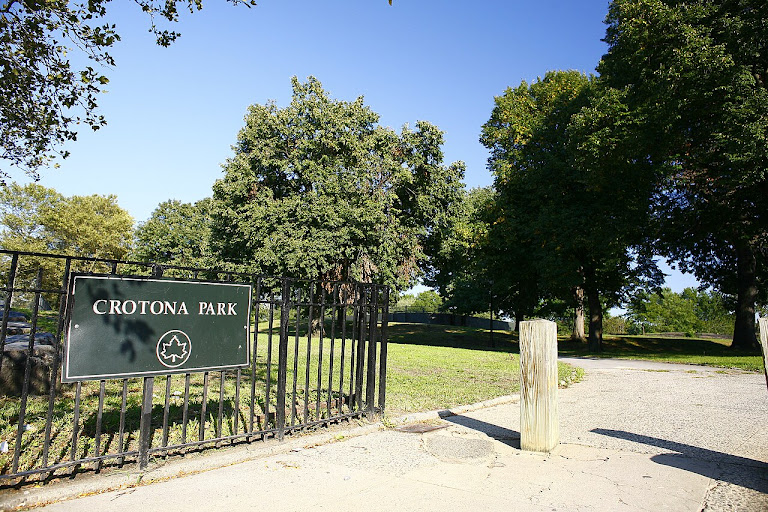
Spanning over 127 acres, Crotona Park plays a pivotal role in the local community, offering a vital space for recreation, sports, and a connection with nature. But this park is more than just a patch of green in the city. It embodies the revitalization of the South Bronx, seamlessly blending natural landscapes, Great Depression-era heritage, modern infrastructure, and active community engagement. Let’s dive deeper into the history of Crotona Park on bronx.name.
The Park’s Genesis
Today, it’s a cornerstone of the Bronx’s park system. Yet, its story began with a dream and a struggle. Back in the 1870s, the legendary landscape architect Frederick Law Olmsted (who designed Central Park) proposed a truly original vision for the Bronx. In contrast to Manhattan’s rigid street grid, he envisioned a natural, curving network of parks and boulevards that would harmonize with the borough’s geography. Unfortunately, the city didn’t initially embrace his idea.
Luckily, other enthusiasts championed the cause. John Mullaly, a journalist and editor for the New York Herald, became the driving force behind the movement to create parks in New York City. He organized the New York Park Association and actively advocated for acquiring land from the Van Cortlandt and Pell families in the Bronx. Despite resistance, he gained support from newspapers and influential lobbyists. In 1884, thanks to their efforts, Governor Grover Cleveland signed the New Parks Act. By 1888, Crotona Park became one of the Bronx’s first six acquired public parks.
Interestingly, the park was initially planned to be called Bathgate Park, but due to a conflict between the park engineer and the Bathgate family, another name was chosen: Crotona, after an ancient Greek city in Italy. The name symbolized natural beauty while also avoiding confusion with the Croton Aqueduct.
Crotona Park’s Transformation in the First Half of the 20th Century
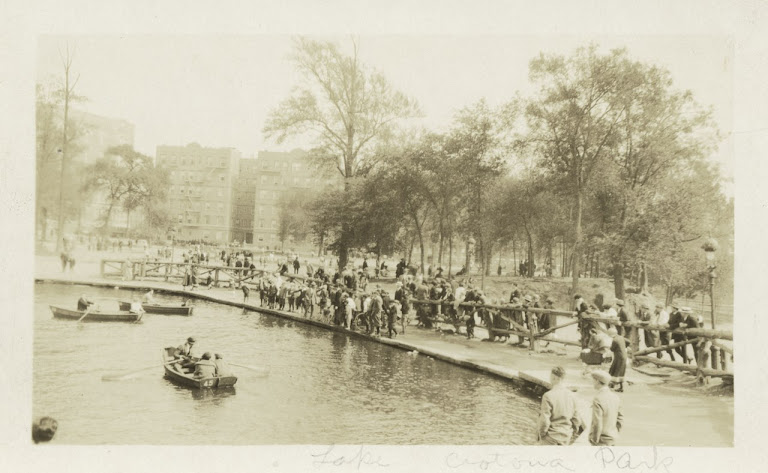
In the early 1900s, a stone pathway appeared around Indian Lake, along with a small kiosk for skaters and even a heated warming hut—these were the first steps toward developing the space for active leisure. Hundreds of American elms were also planted, and the first sports area for schoolchildren was created. However, with recreation came disputes—local landowners complained that concerts and games were too loud and that the bandstand disrupted the peace. Lawsuits even ensued. Despite this, the park continued to grow. The 1910s saw the addition of tennis courts, concrete promenades, streetlights, pathways, and a “Farm Garden” where children learned the basics of agriculture.
A new chapter in the park’s history began with Robert Moses, the legendary city parks commissioner appointed by Mayor Fiorello LaGuardia in 1934. At a time when America was grappling with the Great Depression, Moses initiated a massive recovery program. It put 80,000 unemployed individuals to work on over 1,700 infrastructure projects. One of these was the construction of 23 public swimming pools across New York City. These pools were a true breakthrough, featuring separate areas for diving, swimming, and games, along with changing rooms, grandstands, and underwater lighting. In Crotona Park, the project included a large swimming pool, a children’s pool, and a modern bathhouse.
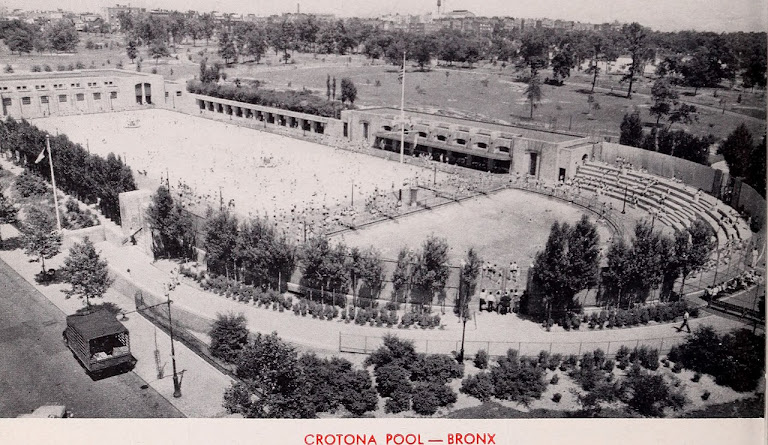
Crotona Park became the only park in the Bronx to see such an ambitious WPA (Works Progress Administration) plan realized. On July 25, 1936, the new pool opened to the public, with 5,000 people attending the ceremony and thousands more waiting outside. From that moment on, the park transformed from just a place for walks into a true aquatic hub for the Bronx.
Development didn’t stop after the pool’s opening. In 1938, nearly $3 million was invested in additional upgrades: sidewalks, new playfields, and recreation areas. By 1941, the park had gained seven new playgrounds and a children’s farm, and its sports areas had been renovated.
Overall, between 1934 and 1960, Crotona Park became a powerful recreational center. During those years, the park also boasted a zoo and a boathouse, attracting visitors from across the city.
Key Events in the Park’s History During the Second Half of the 20th Century
In the post-war years, Crotona Park began to decline. Rising crime rates in the 1950s and 60s left their mark, with gang clashes, a series of robberies, and even a tragic murder. Although authorities tried to respond, including modernizing lighting in 1963, the situation remained tense. Promised playground renovations didn’t happen, benches broke, fountains went unrepaired, and the boathouse ceased operations in 1970.
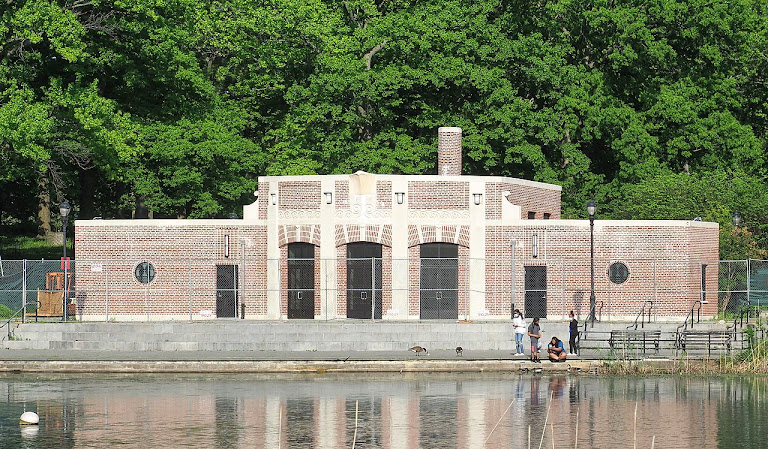
In 1971, the recreation center suffered a devastating act of vandalism. Plumbing and electrical systems were stolen, and buildings were damaged. Windows were boarded up to deter thieves. The financial and social crisis of 1975 hit urban parks even harder. The number of NYC Parks employees plummeted tenfold compared to Moses’s era. Only in 1982, when the budget was restored, did a chance for genuine reconstruction emerge. Repairs began in 1983, and by the summer of 1984, the modernized recreation center reopened its doors to residents.
Simultaneously, the park received updated pathways and benches, and the lake and boathouse were restored. A volunteer ranger program was created to maintain order, which lasted for several years until funds ran out. Yet, even in challenging times, the park remained a focal point: Jimmy Carter, Ronald Reagan, and Bill Clinton all visited, and Pope John Paul II celebrated mass before a multi-thousand-strong congregation in 1979.
However, crime remained a serious problem in the 80s and 90s. Incidents included a pregnant woman being wounded, a shooting, a man being set on fire for a bicycle theft, and a series of sexual assaults in the pool, colloquially dubbed the “jacuzzi.” In 1991, the city planned to close all outdoor pools, but they were saved by donations—including $2 million from developer Sol Goldman’s trust.
During the same period, a movement to revitalize the park emerged. Among its leaders was Elizabeth Barlow Rogers, a Central Park reformer. In 1996, the “Friends of Crotona Park” organization was formed. In 1999, the Lila Wallace Reader’s Digest Fund allocated over a million dollars to renovate five city parks, including Crotona.
Crotona Park in the 21st Century
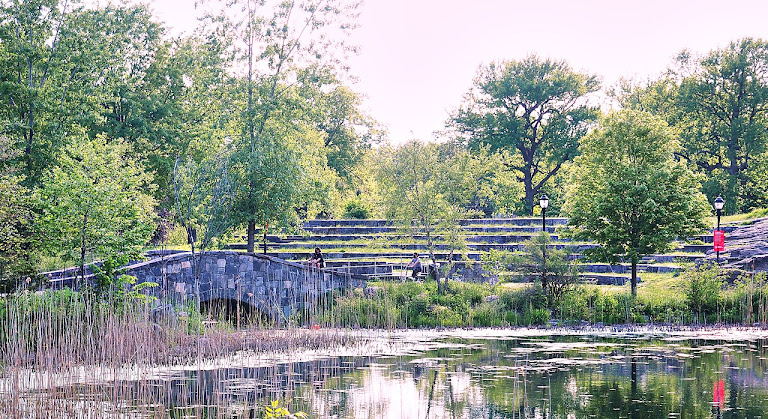
In May 2001, the nature center in Crotona Park reopened after renovations, marking the beginning of a large-scale park restoration. At that time, a special development and management plan was created, envisioning the park as a green bridge connecting surrounding communities. In 2009, the lake was restored, and a new amphitheater for cultural events was built.
In 2014, another renovation of the nature center was approved, and in 2015, the Cary Leeds Center for Tennis & Learning, with its new two-story clubhouse, opened near Indian Lake. That same year, the city’s Parks Department unveiled a master plan for the development of Crotona Park and Tremont Park, which included creating a new cafe, a dog run, a skate park, and more. In 2020, the lanterns on the main entrance towers shone brightly once again, and in 2021, city officials announced plans to repair the roof of the historic bathhouse.
A Modern Center for Recreation and Leisure
Crotona Park is a true oasis for active recreation in the heart of the Bronx. It boasts many trees over 100 years old, with more than 2,400 trees representing over 28 species.
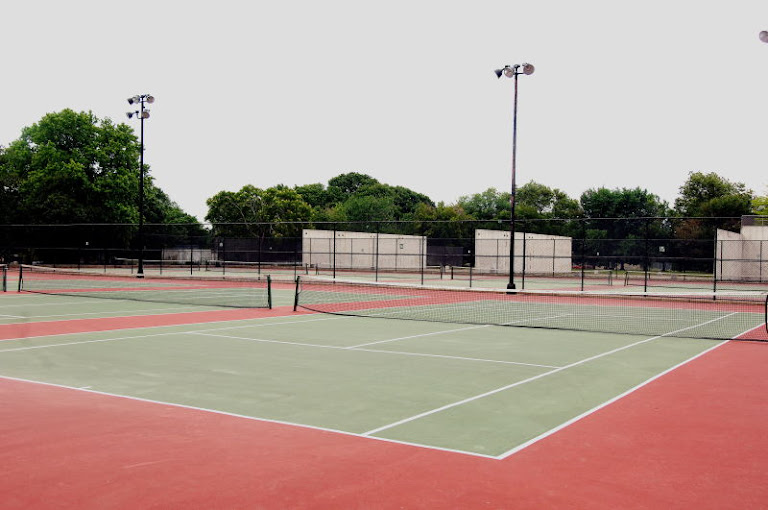
Sports enthusiasts will find plenty to enjoy in the park: indoor courts, gyms, and community centers are all available to residents and visitors. Outdoors, the park features a remarkable 6 baseball fields, 7 basketball courts, 14 handball courts, a soccer field, and a whopping 20 tennis courts. Most of these facilities are open to everyone, although some indoor activities may require membership.
In 2024, plans were unveiled for the construction of the new Gladwin Recreation Center, set to become the cultural and sports hub of the area. This new complex will include modern studios, gyms, media labs, and sports courts—all housed within three buildings connected by a spacious lobby. Construction began in 2025, with an expected opening in 2027.
Crotona Park has also been the stage for notable events. From 1996 to 2012, it hosted the EmblemHealth Bronx Open, a prestigious tennis tournament sanctioned by the International Tennis Federation. The tournament served not only as a warm-up for the US Open but also as a source of support for youth tennis programs in New York. In 2019, the tournament was revived as a WTA event.
On May 23, 2024, the park hosted a high-profile rally for Donald Trump as part of his presidential campaign.
Crotona Park also makes appearances in art: it’s depicted in Abram Manievich’s autumn landscape (1920s). The park is also mentioned in Clifford Odets’ play “Waiting for Lefty” (1935), further cementing its place in New York’s cultural history.
Crotona Park has undergone numerous renovations and improvements, gradually transforming into a beloved spot for walks, sports, picnics, and gatherings for the residents of the South Bronx. Its landscape, history, and spirit of community initiative are still palpable in every pathway.