

Park · the Bronx · ⭐ 9.1/10 · 10176 reviews · updated: 2026-08-04 20:04:51
Address: Middletown Road & Stadium, Avenue, Bronx, NY 10465, United States
Pelham Bay Park — thirteen miles of shoreline at the top of the Bronx
At 2,772 acres, Pelham Bay Park is the largest park in New York City — more than three times the size of Central Park — and it does not behave like a city park at all. Roughly two thirds of it is left in a natural state: oak-hickory forest, salt marsh that floods and drains twice a day, meadow, tidal flats and thirteen miles of shoreline along Long Island Sound. Inside one boundary you will find the city’s only public saltwater beach, a Greek Revival country house that is now a museum, a 375-acre wildlife sanctuary, the city’s only 36-hole public golf complex, a lagoon once dredged as an Olympic rowing trial course, and a split granite boulder that was a landmark here long before Europeans arrived. One subway line ends at its gate, and most New Yorkers who finally make the trip are startled that something this large and this quiet survives inside the five boroughs.
Highlights
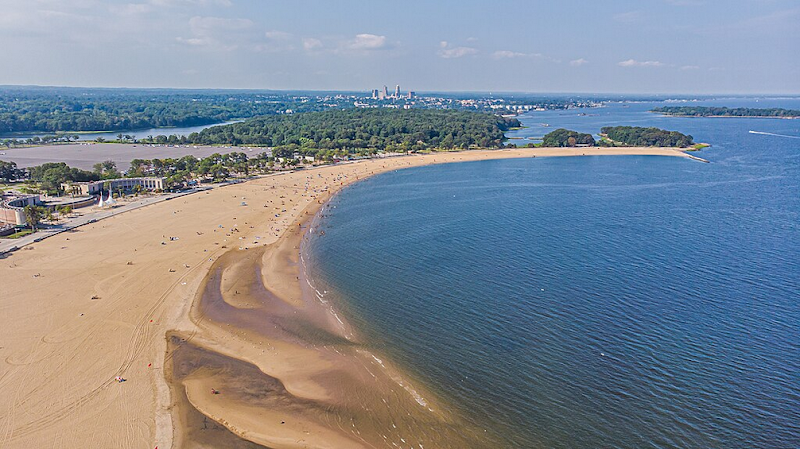
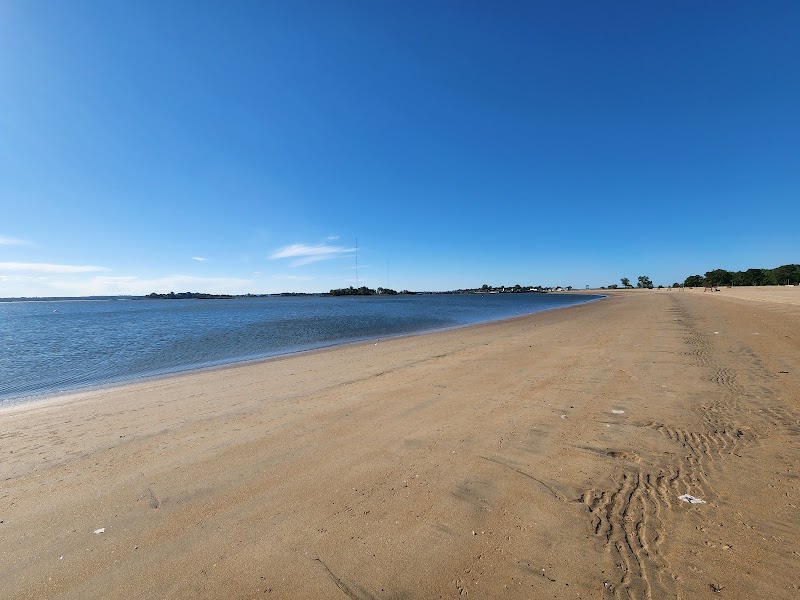
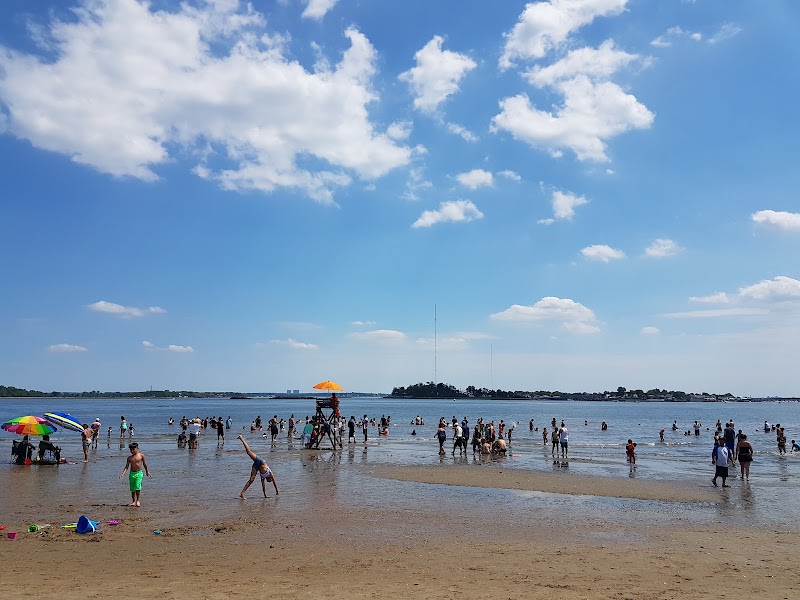
- Orchard Beach — a 1.1-mile crescent of sand divided into thirteen sections, engineered between 1934 and 1937 under Robert Moses by barging in roughly four million cubic yards of sand and joining Hunter Island, the Twin Islands and Rodman’s Neck with landfill. It opened on 25 June 1937 and was promoted as the “Riviera of New York.”
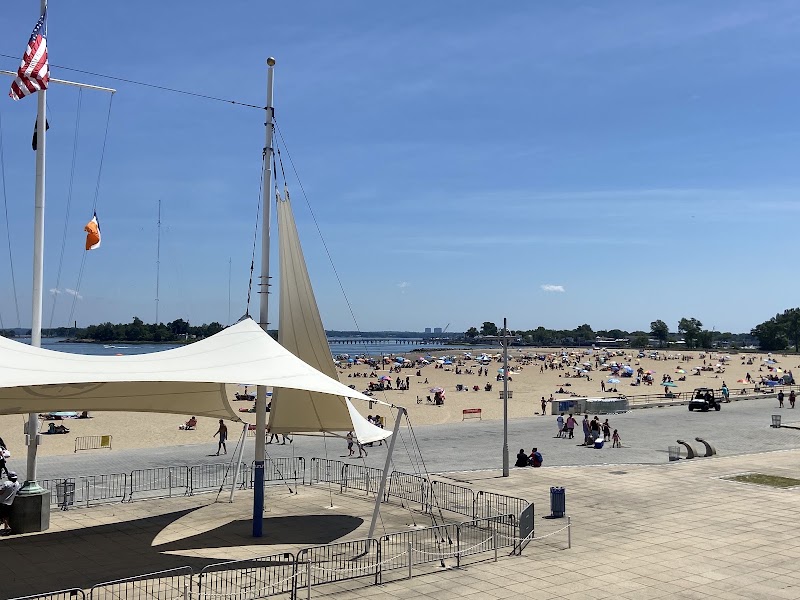
- The Orchard Beach Pavilion — the landmarked 140,000-square-foot bathhouse and promenade designed by Aymar Embury II with landscape architect Gilmore D. Clarke, closed to the public since 2009 and reopened in May 2026 after a full reconstruction that saved the limestone cladding, blue tile, terrazzo, glazed terracotta and the fifty-foot hexagonal-tiled promenade.
- Split Rock — a granite erratic roughly twenty-five feet across, cleaved in two by the retreating ice sheet about ten thousand years ago. Anne Hutchinson, exiled from Massachusetts for her religious dissent, settled beside it in 1642 and was killed with most of her household in August 1643. A bronze tablet placed in 1911 was stolen in 1914.
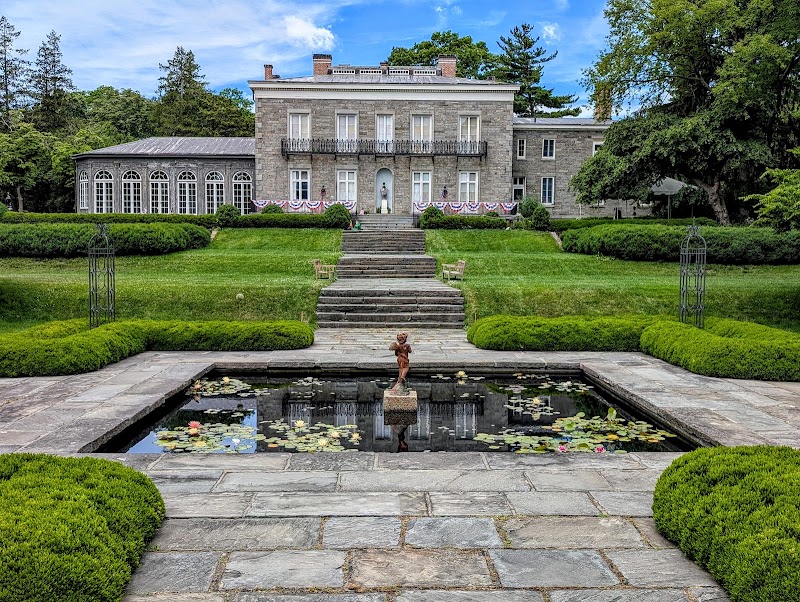
- Bartow-Pell Mansion Museum — a Greek Revival stone house with Federal interiors, built between 1836 and 1842 by Robert Bartow, a Pell descendant, and his wife Maria Lorillard Bartow. Its terraced formal garden, sunken fountain and stone-walled enclosure were laid out from 1914 to 1917 by the International Garden Club; the adjoining carriage house is the last masonry carriage house in New York City to keep its original form.
- Thomas Pell Wildlife Sanctuary — 375 acres of Goose Creek Marsh, the saltwater wetlands along the Hutchinson River, Goose Island and the oak-hickory woods that border the Split Rock golf course, protected as Forever Wild and closed to development.
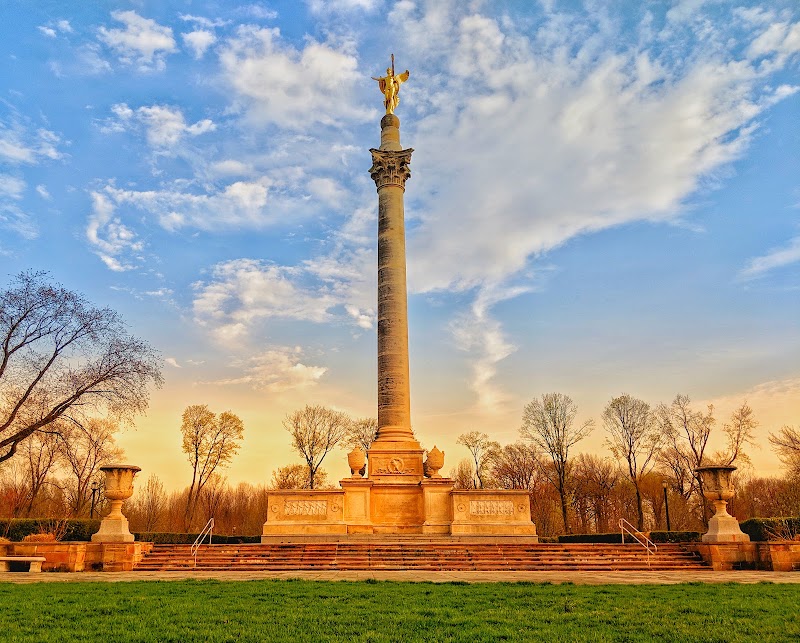
- The Bronx Victory Column and Memorial Grove — a seventy-five-foot Corinthian column crowned by a bronze winged Victory, designed by John J. Sheridan with sculptors Belle Kinney and Leopold Scholz, erected in 1932 and dedicated in September 1933 to the 947 Bronx men who died in the First World War.
What you’ll find
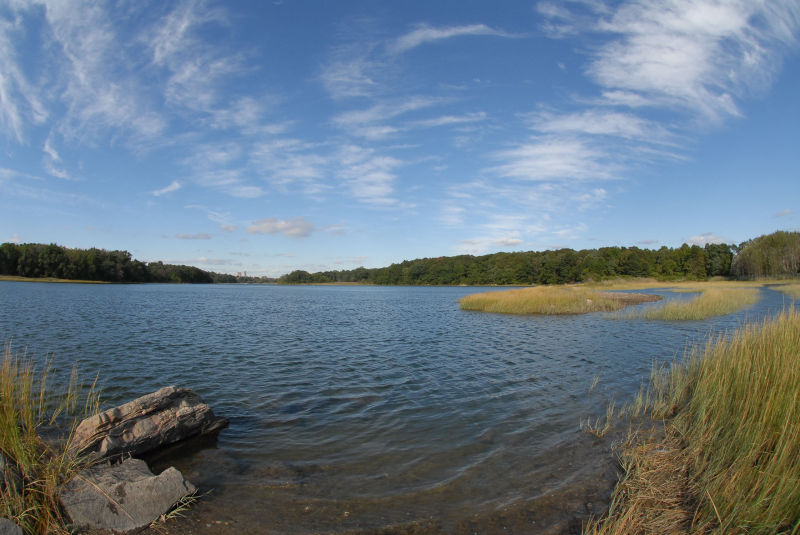
The park’s habitat inventory reads like a nature preserve rather than a municipal lawn: 782 acres of forest, 751 acres of mixed scrub, 195 acres of salt marsh, 161 acres of salt flats, 83 acres of meadow and a few acres of freshwater marsh. Only about a third of the park has been developed at all, and the developed third is generous.
- Hunter Island — 166 acres of former island, now joined to the mainland by the 1930s landfill. John Hunter bought it in 1804 and built a mansion that stood until 1937; the Siwanoy knew the place as Laap-Ha-Wach King.
- The Kazimiroff Nature Trail — opened in June 1986 and named for Theodore Kazimiroff, the Bronx historian and naturalist who died in 1980; it loops through Hunter Island’s woods past glacial erratics and out to the rocky Sound shore.
- The Lagoon — a broad sheltered water body dredged into a four-lane, 2,000-metre course for the 1964 Olympic rowing trials, still used by rowing and paddling clubs.
- Turtle Cove and the salt marsh — an eleven-acre restoration begun in June 2009 that added a canal, a footbridge and roughly ten thousand trees and shrubs to reconnect tidal flow.
- Pelham Bay and Split Rock golf courses — two full 18-hole layouts making up the only 36-hole public golf facility in New York City. Split Rock, designed by John Van Kleek, reopened in June 1935 and runs through the hardest woodland in the park; the Pelham Bay course preserves colonial stone walls associated with the 1776 fighting.
- Sports and stables — Rice Stadium and its surrounding ballfields on the southern peninsula, plus the Bronx Equestrian Center, a working riding stable with bridle paths through forest and marsh, open daily from morning until dusk all year.
Things to do — and who it’s for
- Birders — the park was named an Important Bird Area by National Audubon in 2005; more than 250 species have been recorded here and over eighty have bred. Cooper’s and sharp-shinned hawks are seen almost daily from December through April, and the capped former landfill mound is the traditional hawk-watch station.
- Families with children — Orchard Beach is shallow, sheltered and lifeguarded in season, with playgrounds, basketball, volleyball and handball courts right behind the sand, so a beach day needs no car and no ferry.
- Hikers and trail runners — the Siwanoy Trail runs close to three and a half miles and the Split Rock Trail about a mile and a half through Goose Creek Marsh and the wildlife sanctuary; together with the bridle paths they add up to the longest network of unpaved trail in the borough.
- History-minded visitors — Split Rock, Glover’s Rock, the Bartow-Pell house and the Victory Column let you walk from 1643 to 1776 to 1933 in a single afternoon without leaving the park.
- Golfers — two contrasting 18-hole public courses share one clubhouse, so a group of mixed ability can split between the gentler Pelham Bay and the tougher, tree-lined Split Rock.
- Riders and rowers — trail rides and pony rides from the equestrian centre, and a flat, protected 2,000-metre rowing lane on the Lagoon that few other city parks can match.
Getting there & practical
The park sits at the northeastern corner of the Bronx, wrapping around the Pelham Bay, Country Club and City Island neighbourhoods. The 6 train ends at Pelham Bay Park station, which puts you at the park’s southwestern edge; from there the Bx29 bus runs year-round toward City Island and the Bx12 Select serves Orchard Beach on summer weekends, while Bee-Line route 45 links the park to Westchester. Amtrak’s Northeast Corridor crosses the park but does not stop in it, so there is no useful commuter-rail option. Entry to the park, the beach, the trails and the nature areas is free; the two golf courses, the guided house tour at Bartow-Pell and the summer beach parking lot are the separately paid exceptions, and the mansion’s gardens and grounds stay free even on days when the house is shut. Park land keeps standard NYC Parks hours, from early morning until late at night, while the Bartow-Pell house museum opens Wednesday, Saturday and Sunday afternoons and its grounds open daily from morning until dusk. Swimming at Orchard Beach is only permitted when lifeguards are on duty, which runs from the Memorial Day weekend through Labor Day. Allow half a day for the beach and pavilion alone; a full day if you want the beach, the nature trail and the mansion in one visit.
When to visit
Spring is the birding peak: warblers pour through the Hunter Island woods in late April and May, the shadbush and dogwood come out along the trails, and the marsh greens up before the mosquitoes arrive. Summer belongs to Orchard Beach — arrive before mid-morning on a hot weekend, because the crescent can hold something like a hundred thousand people and the parking lot fills first. Autumn is arguably the best all-round season: the oak-hickory canopy turns late and slowly, the crowds vanish after Labor Day, the salt marsh goes copper, and the hawk migration begins. Winter is stark and rewarding — the Sound shore is empty, wintering ducks and geese raft offshore, Cooper’s and sharp-shinned hawks hunt the meadows daily from December, and Split Rock and the glacial erratics on the Twin Islands are far easier to see with the leaves down. Dress for wind: the shoreline is several degrees colder than the subway station.
Good to know
The land was Siwanoy territory, used for hunting, ceremony and burial, and Dutch colonists claimed it in 1639 under the name Vreedelandt, “land of peace” — an unhappy label, given what followed. In 1654 Thomas Pell negotiated a purchase of roughly 50,000 acres from the Siwanoy, and after Charles II granted a charter in 1666 the holding became the Manor of Pelham; the park keeps the family’s name three and a half centuries later. On 18 October 1776 Colonel John Glover’s brigade of about 750 men fought a delaying action here at the Battle of Pell’s Point, using the stone field walls as cover against a far larger British landing force and buying Washington’s army critical time to withdraw north. Glover’s Rock, a glacial boulder with a commemorative plaque, marks the engagement, though not the exact spot where Glover stood. The park itself was born of the New Parks Act signed by Governor Grover Cleveland in 1884; the city acquired roughly 1,700 acres and the park was formally established in 1888, passing to New York City in 1895 when the eastern Bronx was annexed. Not all of its history is picturesque: Tallapoosa Point served as a municipal dump from 1963 until 1978, was declared a hazardous-waste site in 1988 and cleaned up from 1989 onward, and archaeologists working there after 2012 recovered more than a hundred artifacts from Native American shell middens dated to the third century of the common era. Ecologically the park is still a place of discovery — a 25-acre meadow inside it holds the only known population anywhere of the moth Amphipoea erepta ryensis.
Visitor tips
- Do not try to see the whole park in one visit. Treat it as three separate destinations — the beach and pavilion, the Hunter Island nature trail, and the Bartow-Pell house with the wildlife sanctuary — and pick one per trip.
- Check the day of the week before planning around Bartow-Pell: the house is open only on Wednesday, Saturday and Sunday afternoons, though the gardens and carriage house grounds are open daily and free.
- Wear real shoes on the Kazimiroff and Siwanoy trails. The Sound shore is glacial rock and tidal mud, not paved path, and the marsh sections are genuinely wet after rain and at high tide.
Questions & answers
Is Pelham Bay Park really the largest park in New York City? Yes. At 2,772 acres it is more than three times the size of Central Park and the largest public park in the five boroughs, with about thirteen miles of shoreline on Long Island Sound.
Does it cost anything to enter? No. The park, the beach, the trails, the nature sanctuaries and the memorial grove are all free. The golf courses, the guided tour inside the Bartow-Pell house and the beach parking lot in summer are paid separately.
Can you swim at Orchard Beach? Yes, during the official season from the Memorial Day weekend through Labor Day, and only while lifeguards are on duty. Outside those hours and dates swimming is not permitted, though the promenade and the sand stay open.
Is the Orchard Beach pavilion open again? Yes. The landmarked 1930s bathhouse had been closed to the public since 2009 and reopened in May 2026 after a full restoration; restrooms and the ground floor are in use, with the restored balconies accessible and food and restaurant concessions phasing in afterwards.
How do I get there without a car? Take the 6 train to its terminus at Pelham Bay Park station. From there the Bx29 runs year-round toward City Island and the Bx12 Select serves Orchard Beach on summer weekends; Bee-Line route 45 connects from Westchester.
What is Split Rock and why does it matter? It is a granite glacial erratic split in two roughly ten thousand years ago. Anne Hutchinson, the religious dissenter banished from the Massachusetts Bay Colony, settled next to it in 1642; she and most of her family were killed there in August 1643. It is one of the oldest named landmarks in New York City.
Is the park good for birdwatching? It is one of the best sites in the city. National Audubon designated it an Important Bird Area in 2005; more than 250 species have been recorded and over eighty have nested. Winter raptors and spring warblers are the two highlights.
Can you ride horses in the park? Yes. The Bronx Equestrian Center operates as a concession inside the park with lessons, trail rides and pony rides, and the bridle paths run through both forest and salt marsh. It operates year-round, from morning until dusk.
Photos
Show 1 more photos
Visitor reviews
Reviews last updated: 2026-08-04 20:04:51
Data is refreshed monthly. Sources: bronx.name and editorial picks based on reviews.
Right now, in March 2026, the buildings are completely gutted and under renovation. Everything is closed. It looks like only the tennis courts are open. There are probably 10 dog walkers there and plenty of space and fre…
⭐⭐⭐⭐⭐
A perfect family day at Pelham Bay Park!
We had such a wonderful day at Pelham Bay Park with the whole family! It's a real hidden gem of New York — quiet, spacious and full of natural beauty. From the wide gr…
If you thought Central Park was big, you need to visit this park immediately. There's a big track-and-field facility here that could put even Soundview Park to shame, easy access from the No. 6 train, free parking, tons…
I love this park. I have one closer to me, but it's so overcrowded because of the influx of illegal immigrants that I can't enjoy it anymore. But a visit to this park is a pleasant walk without crowds of people and volle…
This park is pretty crazy. There are a bunch of boisterous youth being loud and obnoxious. They serve nothing but ice cream, so maybe pack something if you plan on staying for a longer duration of time. If you walk over…