

Park · the Bronx · ⭐ 8.5/10 · 3788 reviews · updated: 2026-08-04 20:04:52
Address: 450 St Ann's Ave, Bronx, NY 10455, United States
St. Mary’s Park — the hill that holds Mott Haven together
St. Mary’s Park is the oldest and largest park in the South Bronx: 35 acres of ridge, slope, outcrop and playing field rising above Mott Haven, acquired by the city between 1888 and 1890 as one of the six original Bronx parks. It is the kind of park that a neighbourhood actually lives in rather than visits. The ground has never been flattened — a spine of rock runs down the middle with fields, woods and playgrounds terraced on either side — and the layers of local history are stacked just as steeply: the estate of Jonas Bronck, whose name the borough carries; a Revolutionary War refugee camp; the hill where the ironmaster who cast the dome of the United States Capitol built his house; the borough’s first public playground in 1914; New York’s first full-service indoor recreation centre in 1951; and, since 2021, an amphitheatre named for Gil Scott-Heron.
Highlights
- Janes’ Hill — the park’s high point and its oldest named feature, where Adrian Janes built his mansion after buying the land in April 1857. His firm, Janes, Kirtland & Co., cast the ironwork of the dome of the United States Capitol — a structure weighing 8,909,200 pounds — along with bridges for Central Park and railings for the Brooklyn Bridge.
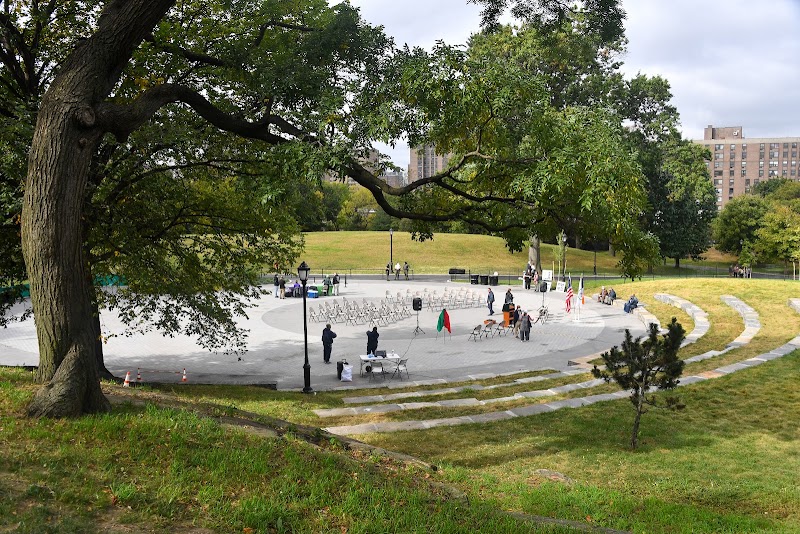
- The Gil Scott-Heron Amphitheater — the park’s performance space, rebuilt and renamed in October 2021 for the poet, musician and author who went to school in the Bronx and whose spoken-word records helped invent the vocabulary of modern hip-hop.
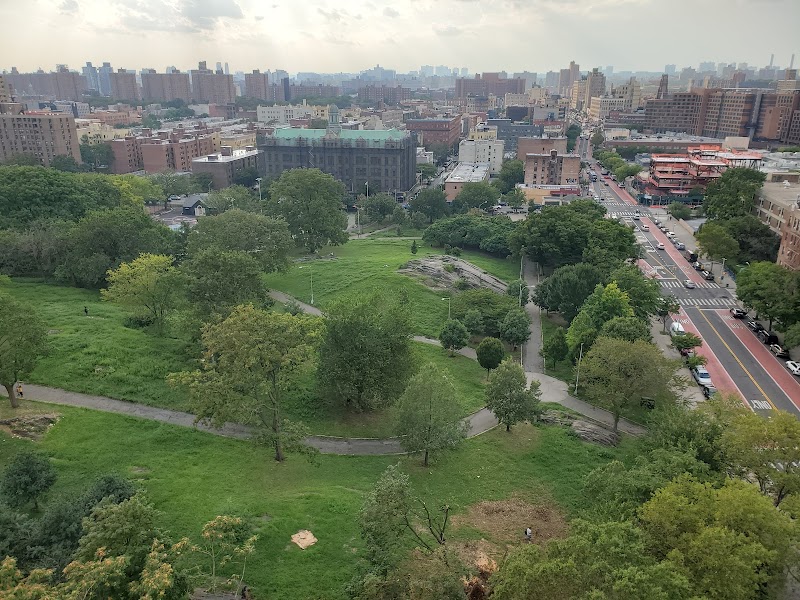
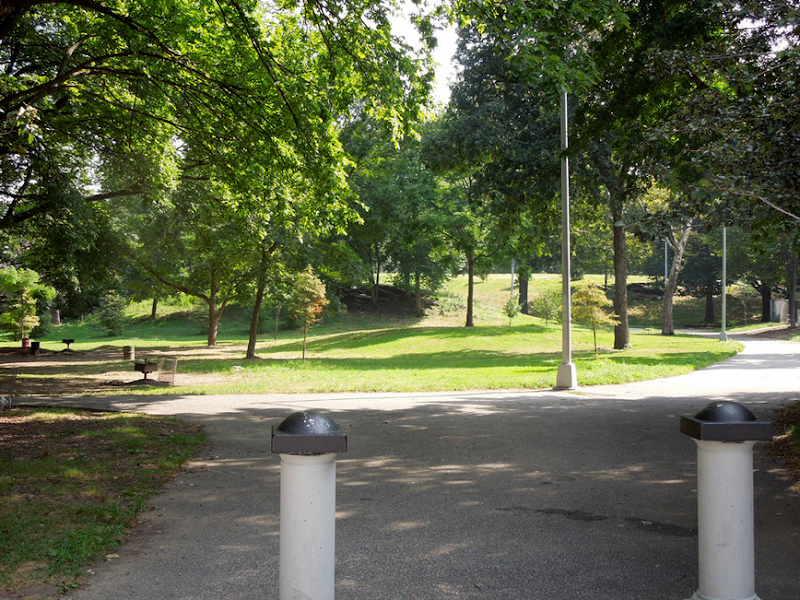
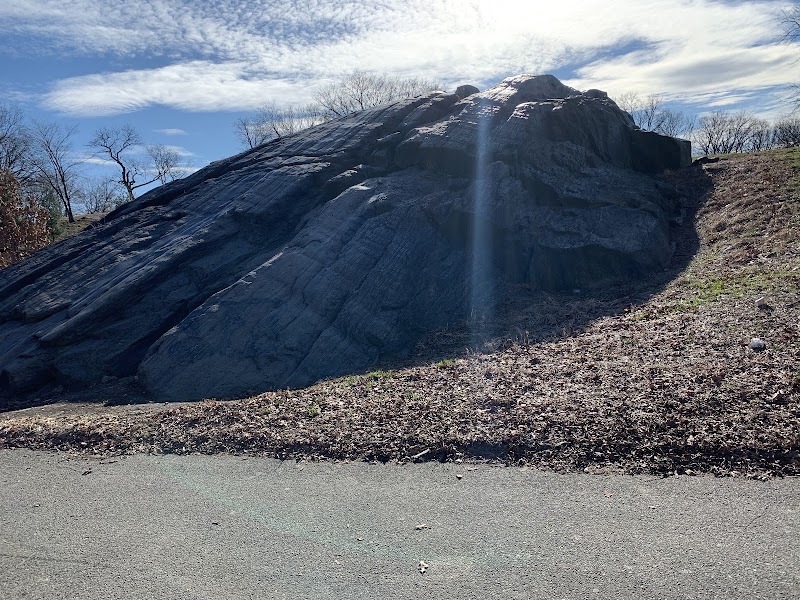
- The terrain itself — hills, rock outcroppings, open fields and woods laid out to follow the natural ridge rather than override it, giving the South Bronx one of the few genuinely undulating public landscapes in the neighbourhood, with long views out over the rooftops.
- St. Mary’s Recreation Center — opened in 1951 as the first full-service indoor recreation centre in New York City, designed by Brown, Lawford and Forbes with an indoor pool, gymnasium, locker rooms and meeting rooms. Marvel Comics murals painted in the early 1970s and refreshed in 1991 are part of its identity.
- The playgrounds — the borough’s first public playground opened here in 1914 with a baseball diamond, two tennis courts and a children’s farm garden. Today Adventure Playground and Sunken Playground carry that tradition, with spray showers, game tables, a garden area and outdoor adult fitness equipment.
- The rebuilt ballfields and dog run — two reconstructed diamonds with spectator seating, sports lighting and accessible seating areas, plus an expanded dog run with its own water fountain, all delivered in the first phase of the city’s Anchor Parks programme in 2018 and 2019.
What you’ll find
At 35 acres this is a park you can cross in fifteen minutes, but the gradient means it never reads as small: paths climb, drop and turn, and each terrace has a distinct use. Two rounds of major reconstruction between 2018 and 2021 rebuilt almost every surface in it.
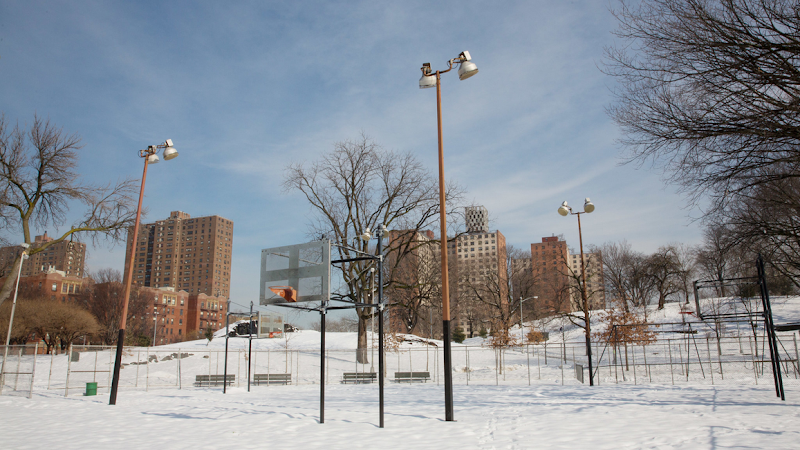
- Ball fields and courts — reconstructed baseball diamonds with seating and lighting, basketball courts and open field space used constantly by school and league teams.
- Four play areas — including St. Mary’s Playground West, renovated between 2018 and 2019 with rebuilt basketball courts, swings, spray showers and upgraded picnic and seating areas.
- The plaza and spray shower at the northern edge — remade in the 2021 works with new seating, planting and lighting, functioning as the park’s main gathering doorstep.
- Woodland and planted slopes — the wooded shoulders of the ridge, replanted for biodiversity during the recent reconstruction, with mature canopy over the paths.
- Decorative fountains and a rain garden — installed in 2019 on the site of a natural pond that appears on an 1865 map and had vanished by 1924; the pond once drained into Bungay’s Creek and on into the East River.
- The recreation centre building — a 1951 landmark of civic architecture, closed since 2022 for a deep reconstruction that added an elevator to every floor, a rebuilt lobby, new restrooms and a modern fire alarm system.
Things to do — and who it’s for
- Local families — four rebuilt play areas, spray showers for hot afternoons, game tables and picnic seating, all free and all within a few minutes’ walk of each other.
- Runners and walkers — the ridge gives real elevation change inside a compact loop, which makes it one of the few places in the South Bronx where you can train on hills without leaving the neighbourhood; free community group runs are held here.
- Ball players — two reconstructed diamonds with lighting and seating, plus basketball courts, keep the park in use from after school until late evening in season.
- Dog owners — an expanded, fenced dog run with its own water fountain, one of the better-equipped runs in the southern half of the borough.
- Music and event audiences — the Gil Scott-Heron Amphitheater hosts summer concerts, community events and neighbourhood programming in a purpose-built seating bowl.
- Anyone interested in Bronx history — the park compresses four centuries into a single hill, and the story is legible on the ground once you know where Janes’ Hill is.
Getting there & practical
The park sits in Mott Haven in the far south of the borough, a short walk from Port Morris and the Hub. The 6 train is the most direct approach, stopping at East 143rd Street–St. Mary’s Street and at Cypress Avenue on either side of the park; the 2 and 5 trains stop at Third Avenue–149th Street a few blocks north, which is also the borough’s main transfer point. Local buses Bx17, Bx19 and Bx4 pass close by, and the M125 links across to Manhattan. Everything in the park is free — the playgrounds, fields, amphitheatre, dog run and paths carry no charge, and the recreation centre operates on the city’s membership system rather than a per-visit ticket. Park hours follow the standard NYC Parks schedule from early morning to late evening. One important practical note: the recreation centre has been closed for reconstruction since 2022 and its reopening has been pushed back more than once, most recently into 2026, so confirm its current status before planning a swim or a gym session around it. For the park itself, allow forty-five minutes to an hour to walk the whole site including the hill, or a full afternoon if children are using the playgrounds.
When to visit
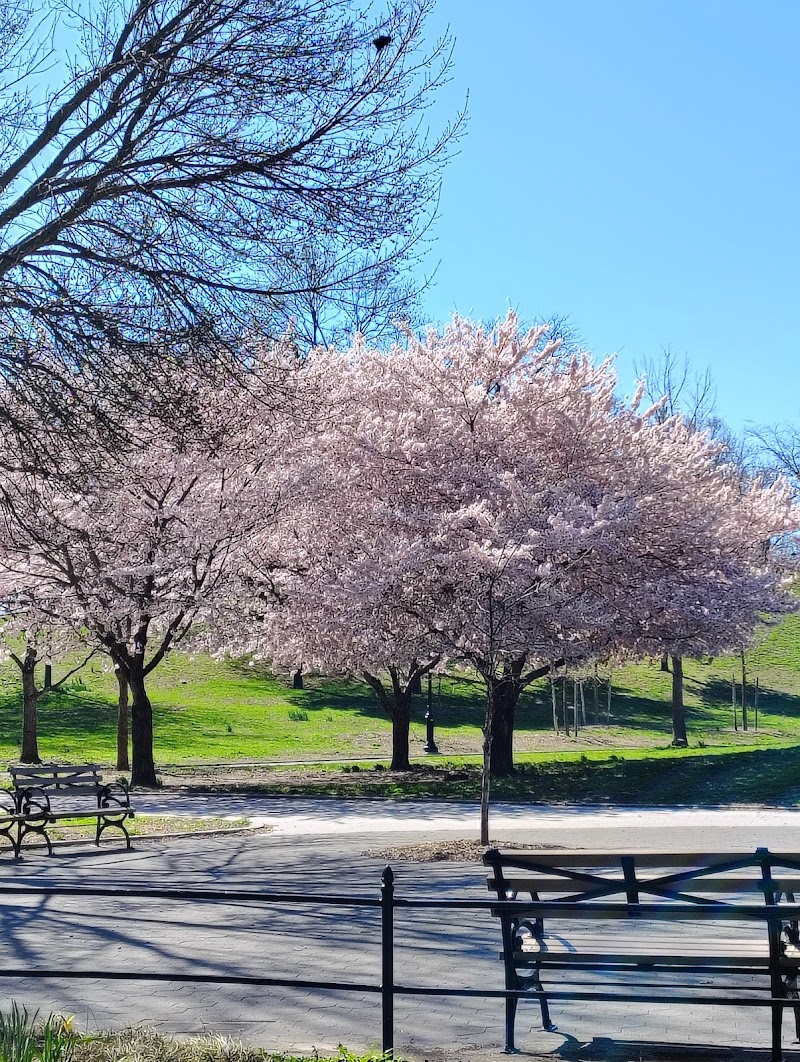
Spring brings the park back into use after winter: the slopes green up, the new planting from the 2021 reconstruction comes into leaf, the ball fields reopen, and the hill is at its most pleasant to climb before the summer humidity. Summer is the busiest and most social season — spray showers running, the amphitheatre programmed with concerts and community events, ball games under lights into the evening, and enough mature canopy on the wooded slopes to find real shade. Autumn is the quietest and arguably the prettiest: the trees on the ridge turn, sightlines open up as the leaves thin, and the paths are ideal for a walk or a hill run in cool air. Winter reveals the geology — the rock outcrops that shaped the whole layout stand out clearly, the views over the neighbourhood lengthen, and the park keeps working as a through-route and a dog-walking ground even when the fields are empty.
Good to know
The ground here has passed through the hands of some of the most consequential names in the borough’s story. It was part of the estate of Jonas Bronck, the settler who arrived in 1639 and for whom the Bronx is named; during the Revolutionary War a group of Loyalist military refugees camped on the site; and it later belonged to the family of Gouverneur Morris, the statesman who wrote the preamble to the United States Constitution. In April 1857 Adrian Janes bought the land from Gouverneur Morris II and built his mansion on the summit, one of five houses set on the property’s high points, and the hill has carried his name ever since. Janes was no ordinary landowner: his foundry, Janes, Kirtland & Co., cast the ironwork for the dome of the United States Capitol, weighing nearly nine million pounds, as well as bridges for Central Park and railings for the Brooklyn Bridge. The park’s name comes from St. Mary’s Episcopal Church, which stood a short distance to the west until 1959; a persistent local tradition also connects it to Adrian Janes’s daughter Mary. The city bought the land between 1888 and 1890, following the campaign of the journalist John Mullaly, who founded the New York Park Association in 1881 — St. Mary’s was one of the six original parks of the Bronx and remains the oldest in the South Bronx, though it is not the oldest in the borough as a whole, since all six date to the same wave of acquisitions. Its record of firsts continued into the twentieth century: the borough’s first public playground opened here in 1914, and New York City’s first full-service indoor recreation centre opened in 1951. The most recent chapter is the city’s Anchor Parks investment — a first phase in 2018 and 2019 that rebuilt the ballfields, seating, lighting and the dog run, and a second phase completed in October 2021 that reconstructed the amphitheatre, the plaza, Adventure Playground, the drainage and the planting, and gave the amphitheatre the name of Gil Scott-Heron.
Visitor tips
- Check whether the recreation centre has reopened before you count on the pool or the gym — the building has been under reconstruction since 2022 with a repeatedly delayed reopening. The outdoor park is unaffected and fully open.
- Come in via the 6 train and walk uphill toward Janes’ Hill first. Taking the high ground early gives you the whole layout at a glance and makes the rest of the visit downhill.
- The park is genuinely steep in places. If you are pushing a pram or have limited mobility, stay on the northern and eastern terraces, where the rebuilt paths, plaza and playgrounds are level and accessible.
Questions & answers
Is St. Mary’s really the oldest park in the Bronx? It is the oldest park in the South Bronx, and one of the six original Bronx parks, with the land bought by the city between 1888 and 1890. Because all six came out of the same acquisition wave following the New Parks Act campaign, calling it the single oldest park in the whole borough overstates the case.
How big is it? About 35 acres, which makes it the largest park in the South Bronx even though it is small by the standards of Pelham Bay or Van Cortlandt.
Does anything in the park cost money? No. The playgrounds, ball fields, amphitheatre, dog run and paths are all free. The indoor recreation centre uses the city’s standard membership system rather than charging per visit.
Is the recreation centre open? It has been closed for a major reconstruction since 2022, with the reopening date pushed back several times into 2026 after structural, drainage and facade problems were uncovered. Check the current status before travelling for it specifically; the outdoor park remains open throughout.
Who was Adrian Janes and why does the hill carry his name? He was the owner of Janes, Kirtland & Co., the Bronx iron foundry that cast the dome of the United States Capitol, bridges in Central Park and railings for the Brooklyn Bridge. He bought this land in April 1857 and built his mansion on the summit, which has been called Janes’ Hill ever since.
Which subway should I take? The 6 train is closest, with stations at East 143rd Street–St. Mary’s Street and Cypress Avenue on either side of the park. The 2 and 5 stop at Third Avenue–149th Street a few blocks to the north. Buses Bx17, Bx19 and Bx4 also serve the area, and the M125 connects to Manhattan.
Why is the amphitheatre named for Gil Scott-Heron? Because the poet, musician and author was schooled in the Bronx and is one of the borough’s defining cultural figures. The rebuilt performance space was formally renamed for him in October 2021 as part of the second phase of the park’s reconstruction.
Is the park good for children? Yes. There are four play areas including the recently rebuilt Adventure Playground and Sunken Playground, spray showers for hot days, game tables, a garden area and a comfort station, all rebuilt within the last few years.
Photos
Show 1 more photos
Visitor reviews
Reviews last updated: 2026-08-04 20:04:52
Data is refreshed monthly. Sources: bronx.name and editorial picks based on reviews.
My next destination is the dog park. I love taking my kids there to get wet at the sprinklers. The baseball field is pretty big, and you can play various sports there. I'd like to find out about the pool section (indoors…
A South Bronx classic. Hills, huge rocks you can climb, real terrain. The indoor pool at the rec center is open year-round. There are always games going on at the baseball fields, and the fitness mile is decent for a run…
Another great, easily accessible park right by the Bx4 or Bx19 routes; plus several other buses and trains. With its amazing size, plenty of interesting spots and a fairly calm atmosphere, I highly recommend visiting thi…
A nice, quiet and clean park! I needed to take a business call, and I found this park perfect! It was quiet, with nice new benches and just enough foot traffic to insulate the city noise, and they thought I was at home.…
Considering the insanely large amount of trash and dog poop that people leave everywhere every day, the park staff does a great job keeping it clean. Lots of dogs off leash. It's a nice park with various playgrounds, an…